Essex is changing.
Over the last few summers, many homeowners have noticed the same pattern. Lawns turn brown, vegetable gardens need constant watering, and ornamental planting begins to struggle after just a few weeks without rain.
The problem isn’t always the weather.
Often, it is the way the garden has been designed.
A Garden That Works Against Nature
Many modern gardens follow a similar formula:
- Large areas of artificial grass.
- Decorative gravel.
- Narrow planting beds.
- Shallow raised vegetable beds.
- Very few trees or large shrubs.
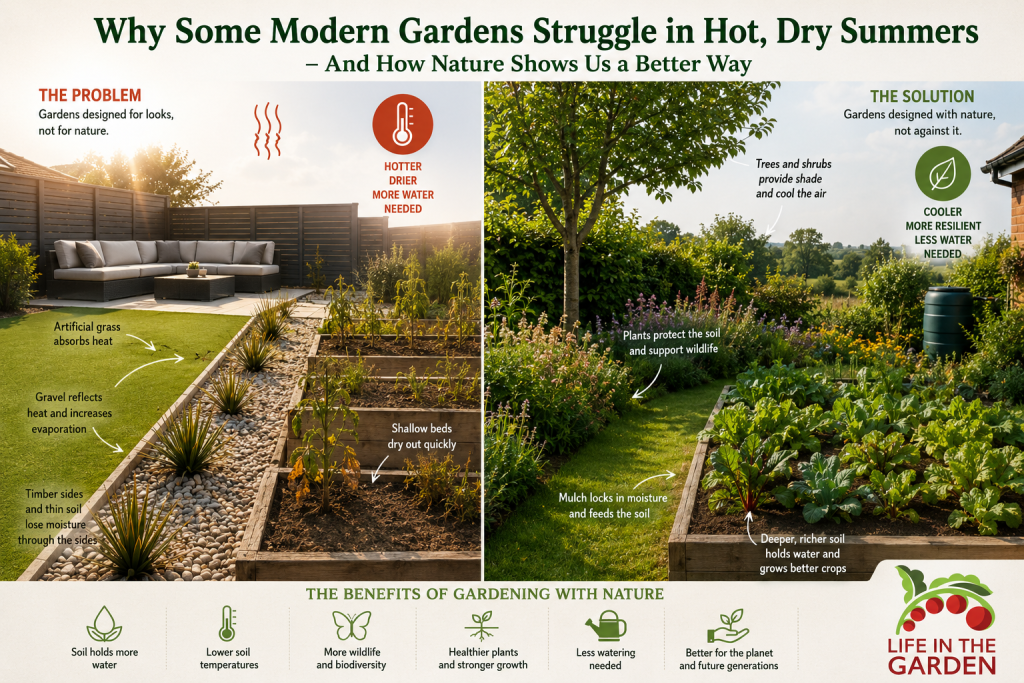
They look neat and require little mowing, but during prolonged dry weather they create an environment that becomes hotter and drier than the surrounding landscape.
Artificial grass absorbs heat from the sun and can become extremely hot on summer afternoons. Gravel stores heat and reflects it onto nearby plants. Raised beds with only 30 cm of soil have a limited water reserve, and because the sides are exposed to the air, they lose moisture much faster than soil in the ground.
The result is a garden that needs increasing amounts of irrigation just to maintain healthy plants.
Nature Rarely Leaves Bare Ground
If you walk through Epping Forest or across an undisturbed meadow, you won’t find large areas of exposed soil.
Nature protects the ground with vegetation, fallen leaves, organic matter and living roots.
These natural layers:
- reduce evaporation,
- keep the soil cooler,
- improve water infiltration,
- feed soil organisms,
- and slowly build fertile, sponge-like soil.
Healthy soil can hold remarkable amounts of water, helping plants survive dry periods with much less irrigation.
A Better Approach
A drought-resilient garden doesn’t have to look wild or untidy.
Simple changes can make a huge difference:
- Replace some artificial surfaces with planting.
- Increase the depth of vegetable beds wherever possible.
- Add compost every year to improve soil structure.
- Apply organic mulch to reduce evaporation.
- Plant shrubs and small trees that provide afternoon shade.
- Collect rainwater for irrigation.
- Choose plants that are naturally suited to the increasingly warm and dry conditions of southeast England.
Each of these measures improves the garden’s ability to retain moisture and support wildlife at the same time.
Gardening for the Future
Climate models suggest that southeast England is likely to experience hotter, drier summers in the years ahead, with more rainfall falling during winter instead.
Rather than fighting these changes with increasing amounts of irrigation, we believe gardens should be designed to work with nature.
A well-designed garden can be beautiful, productive, wildlife-friendly and remarkably resilient—even during challenging summers.
At Life In The Garden Ltd, we believe the gardens we create today should still be thriving decades from now. By restoring healthy soils, increasing biodiversity and designing with natural processes in mind, we help gardens become more sustainable, more enjoyable and better prepared for the changing climate.