Why the Sound of Summer Matters More Than Ever
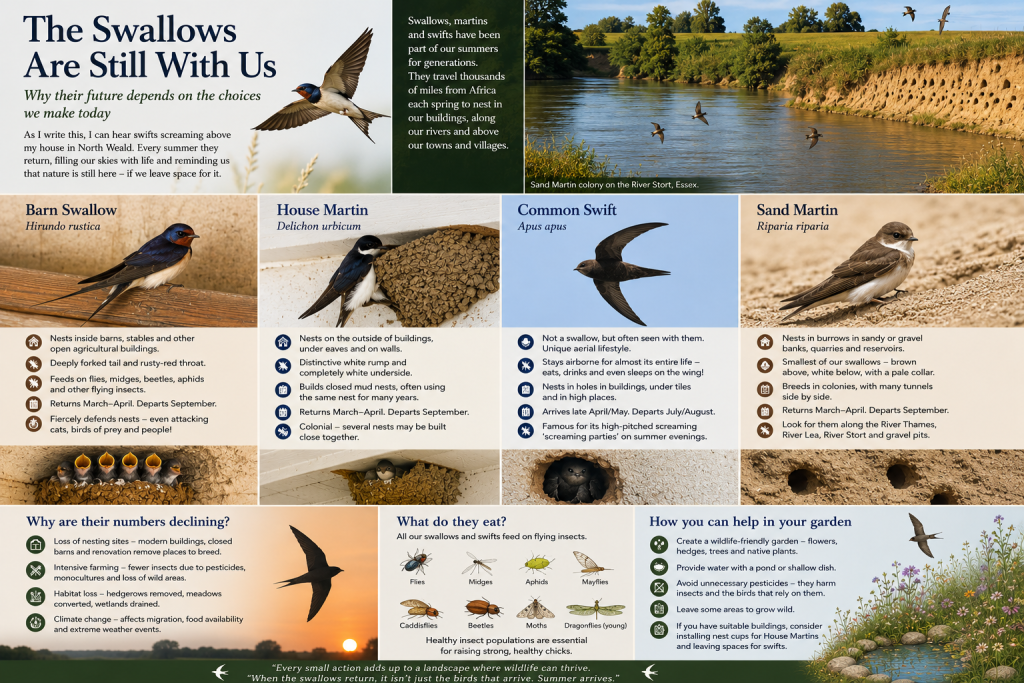
“As I write this article, I can hear swifts screaming above my house in North Weald. Every summer they return, filling the evening sky with their unmistakable calls. It reminds me of my childhood in southern Hungary, where the arrival of swallows meant one thing: summer had truly begun.”
If you grew up in Britain a few decades ago, you may remember something similar.
Swallows nesting in barns.
House Martins plastering mud nests beneath the eaves.
Swifts racing between rooftops on warm evenings.
For generations these birds were simply part of summer. We rarely stopped to think about them because they seemed as reliable as the seasons themselves.
Today, many people feel something has changed.
Although these remarkable birds still return from Africa every spring, their numbers have declined across much of Europe. Modern farming, changing buildings, habitat loss and declining insect populations have all played a role.
Perhaps what we miss most is not only the birds themselves, but what they represented—a landscape that was full of life.
Three Remarkable Summer Visitors in Essex
Barn Swallow (Hirundo rustica)
The Barn Swallow is probably Britain’s best-known swallow.
With its deep forked tail, glossy blue-black back and rusty-red throat, it is one of the finest aerial hunters in Europe.
For centuries Barn Swallows nested inside barns, stables and open agricultural buildings. They became so closely associated with people that many farms expected them to return to exactly the same nesting places each spring.
One behaviour has fascinated me since childhood.
When a cat approached the nest, the swallows became fearless. They would dive repeatedly at the predator, sometimes striking it with their wings before disappearing into the air again. For such a small bird, their courage is extraordinary.
Each swallow may consume thousands of flying insects every day—flies, aphids, beetles and many other species that most of us never even notice.
House Martin (Delichon urbicum)
House Martins are often confused with swallows, but they are easy to recognise once you know what to look for.
Their bright white rump and completely white underside distinguish them immediately.
Unlike Barn Swallows, they build enclosed mud nests beneath roof eaves.
Watching them collect tiny pellets of wet mud is remarkable. Thousands of journeys may be needed to complete a single nest, which is then used by generation after generation.
Modern buildings have made life more difficult for House Martins.
Smooth wall finishes, renovated roofs and the removal of old nests have reduced the number of suitable nesting sites.
Common Swift (Apus apus)
Although we call them swifts, they are not actually swallows.
In fact, they belong to a completely different group of birds.
Yet few species capture the feeling of summer quite like the Common Swift.
Their high-pitched screaming calls echo above North Weald every evening throughout June and July.
Swifts spend almost their entire lives in the air.
They feed while flying.
They drink while flying.
They collect nesting material while flying.
Young birds may remain airborne for many months after leaving the nest without landing once.
Only when breeding do they return to buildings to raise their young.
Once you understand this, every evening flight becomes even more impressive. These birds are among the greatest aerial athletes on Earth.
Sand Martin (Riparia riparia)
The smallest of Britain’s swallows, the Sand Martin, lives a very different life.
Instead of buildings, it nests in tunnels excavated into steep sandy or gravel banks.
Natural river cliffs, gravel pits and specially created nesting banks all provide suitable breeding sites.
Unlike the huge colonies I remember from the River Dráva in Hungary, where thousands of nesting holes covered collapsing riverbanks, Essex populations are generally smaller and more scattered.
Nevertheless, the species still breeds successfully in the county wherever suitable nesting banks remain.
Why Are They Declining?
There is no single cause.
Instead, several changes have happened at the same time.
Traditional barns have disappeared or become sealed buildings.
Old nesting sites have been lost through renovation.
Intensive agriculture has simplified the countryside.
Most importantly, there are fewer flying insects than there once were.
Swallows and swifts depend almost entirely on aerial insects.
When insect abundance declines, raising healthy chicks becomes increasingly difficult.
Can One Garden Make a Difference?
Not by itself.
One wildlife-friendly garden will not reverse national population declines.
But every healthy garden contributes something valuable.
A flowering hedge.
A pond.
Native trees.
Wildflower patches.
Fewer unnecessary insecticides.
Healthier soils.
These features support countless insects—not just bees and butterflies, but also hoverflies, non-biting midges, lacewings, caddisflies and many other species that form the foundation of the food web.
Every successful swallow begins with healthy insect populations somewhere in the surrounding landscape.
The Sound of Summer
When I hear the swifts over North Weald, I don’t simply hear birds.
I hear continuity.
I hear a reminder that, despite all the changes around us, nature still returns each spring if we leave space for it.
Perhaps that is why I enjoy creating wildlife-friendly gardens so much.
Not because one garden will save the swallows.
But because every pond, every native hedge, every flowering meadow and every healthy habitat becomes another small piece of a living landscape.
And if enough people create those small pieces…
Perhaps one day the sound of summer will become just a little louder again.
Norbert Biczo
Owner of Life In The Garden Ltd